
Rotary glide path system
TransformSTM MicroPath
Third-party names identify file systems and workflow compatibility only. No affiliation, sponsorship or endorsement is implied. Trademark notice.
Premium Performance. Single-Use. Exceptional Value.
Protocol card Explore Hybrid Micropath Negotiating Techniques in Calcified Canal Systems
Compatible with all glide path files
MicroPath sequence
Three precise guide path sizes
Progressive preparation from #13 through #17.
Advanced manufacturing technology


Product film
MicroPath, in motion.
57-second product film TransformS™ MicroPath
Restricted-access option
The MB2 - Mini Magic File
At 17 mm, the MicroPath MB2 file leaves more room for the handpiece and mirror in tight posterior access.
- Tip / taper
- 15/.05
- Length
- 17 mm
- Pack
- 6 files
Confirm the pathway with a small hand file, then work in short 1–2 mm advances. Withdraw, clean and irrigate between advances.

Interactive anatomy
Explore the upper first molar in 3D
Three danger points—and why MicroPath matters
Scroll to read all three danger points ↕Danger point one: the first bend
Finding MB2 is only the beginning. Beyond the pulp chamber, the canal may curve abruptly. A hand file can enter, then stop, but resistance does not always mean the canal is blocked.
A stiff stainless-steel file may press into the dentine instead of following the curve. Forcing it risks creating a ledge that makes further negotiation difficult. Moving from size ten to size fifteen increases tip diameter by fifty percent and reduces flexibility.
Use small, appropriately pre-curved hand files for exploration. Respect the length they can negotiate without force, and reassess if progress stops.
The seventeen-millimetre MicroPath MB2 file is designed for this first danger point. Its nickel-titanium Flex-Ion construction provides flexibility for abrupt curves within the first three to five millimetres. Its short format creates handpiece headroom, while the size fifteen tip and point-zero-five taper provide an initial preparation step. The aim is controlled entry along the anatomy without creating a ledge.
Danger point two: the deeper curve
Passing the first bend does not mean the canal is straight. Deeper in the root, it may change direction again where the mesio-buccal one and mesio-buccal two canals meet. A hand file may pass the first curve but meet resistance here. Continued pressure can create a second ledge, sometimes obscured on a bite-wing radiograph.
MicroPath size thirteen and fifteen glide-path files are designed for this deeper pathway. Both have a point-zero-three taper. Size thirteen provides an intermediate step between ten and fifteen; size fifteen develops the glide path further when anatomy permits. Their smaller taper limits the increase in diameter along the working portion.
This creates a controlled transition to a reproducible glide path before larger shaping files are introduced. These files support careful exploration; they do not replace it. Let anatomy and tactile feedback guide each step.
Danger point three: instrument stress
At a deeper curve, a rotating instrument undergoes repeated tension and compression. Cyclic fatigue may cause separation, leaving a fragment toward the apex. Binding can also create torsional overload.
MicroPath establishes the glide path before larger shaping files encounter this anatomy. The short MB2 file manages initial access, followed by a size thirteen or fifteen glide-path file as appropriate. Each instrument has a defined role, rather than forcing one file through every stage. Flex-Ion technology is designed to add safety in this demanding zone.
A University of Pennsylvania study by Iqbal, Kohli and Kim recorded eighty-one separated instruments in four thousand eight hundred and sixty-five endodontic cases. Almost eighty-three percent occurred in the apical third.
MicroPath supports a safer sequence: establish entry, develop a confirmed glide path, then shape while respecting the curvature.
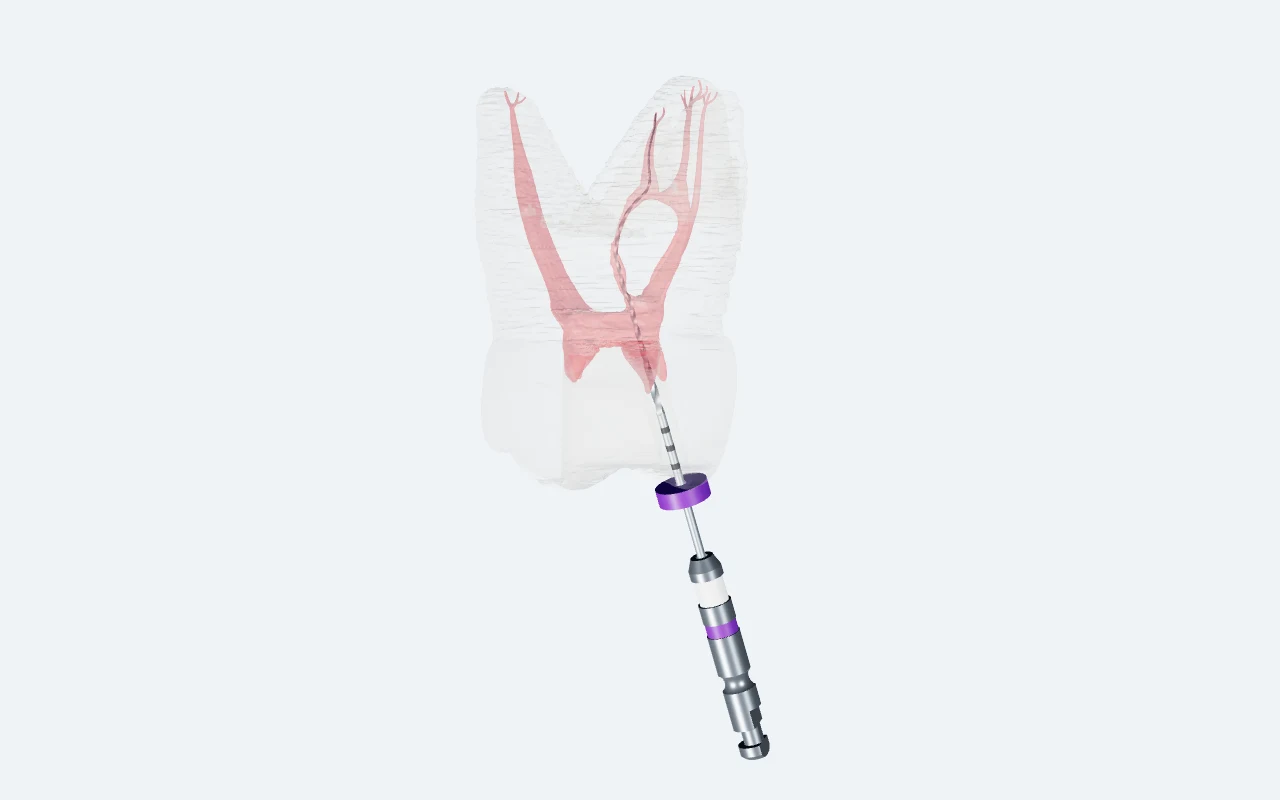
Rotate · zoom · isolate canals · inspect apical branches
MB2 glide path: the thicker rotating file follows the approved route to its apical endpoint, with the single 21 mm CAD stopper seated at the top cusp reference. Non-to-scale educational animation; wall contact/overlap is permitted, not simulated as cutting or a clinical file-fit measurement.
Watch video insteadFile-system protocol
Downloads
TransformS™ MicroPath protocol card
PDF · 2 pages · Glide-path sequence and motor settings.
Swipe left to view part numbers
| File | Length | Pack | Part number |
|---|---|---|---|
| 13/.03 | 21 mm | 6 | TSMP-130321RF |
| 13/.03 | 25 mm | 6 | TSMP-130325RF |
| 13/.03 | 29 mm | 6 | TSMP-130329RF |
| 15/.03 | 21 mm | 6 | TSMP-150321RF |
| 15/.03 | 25 mm | 6 | TSMP-150325RF |
| 15/.03 | 29 mm | 6 | TSMP-150329RF |
| 17/.03 | 21 mm | 6 | TSMP-170321RF |
| 17/.03 | 25 mm | 6 | TSMP-170325RF |
| 17/.03 | 29 mm | 6 | TSMP-170329RF |
| 20/.03 | 21 mm | 6 | TSMP-200321RF |
| 20/.03 | 25 mm | 6 | TSMP-200325RF |
| 20/.03 | 29 mm | 6 | TSMP-200329RF |
| 25/.03 | 21 mm | 6 | TSMP-250321RF |
| 25/.03 | 25 mm | 6 | TSMP-250325RF |
| 25/.03 | 29 mm | 6 | TSMP-250329RF |
| 15/.05 | 17 mm | 6 | TSMP-150517RF |
Part numbers reflect the current EndoTech USA product register. Product availability, approved labeling, and IFU documentation govern.